Safety Guide
Can You Go Canyoning in the Rain?
A practical guide to winter and bad weather in Málaga
TL;DR: Yes, you can go canyoning in winter, and even on a rainy day, but it depends mainly on the canyon and on the particular circumstances around it. Some canyons become dangerous after a few hours of rain. Others are much more fun with more flow, or on a rainy day.
Here is how to tell the difference, what changes when it rains, and what to ask before you book.
About this guide. It focuses on canyons in the south of Spain, and specifically in the province of Málaga. It would be impossible to cover every canyon in the world, or even to generalise about those in Spain: a canyon in the Pyrenees does not behave like one in Andalusia, and what is true for one can be wrong for the other.
Why rain changes everything in a canyon
A canyon is a narrow channel, and everything that falls on the hills around it ends up flowing through it. That is why many canyons are simply off-limits during rainy spells: the flow can grow quickly and become dangerous. Canyon floods are often triggered by storms miles away, and the water level can rise within minutes.
Many factors decide how a canyon reacts, and they add up:
The river basin
The flow does not depend on the rain over the canyon, but on all the land that drains into it, which can cover many square kilometres. A storm in the mountains upstream can send water down the canyon hours later, while the sky above you is perfectly clear.
Tributaries
Every stream that joins the river above the canyon adds its own water. A canyon that looks small can end up fed by a much larger system, and the further downstream you go, the more water there usually is.
Water stored upstream
Dams and reservoirs can hold back a lot of water and calm the flow, but only while they have room left. How full they are on the day matters as much as the dam itself, because once a reservoir is full, what comes in goes out.
Water from the canyon walls
When it rains hard, water also pours off the rock and through small side gullies straight into the channel. These little streams are easy to overlook, but together they add a lot of water, and they react very quickly.
How wet the ground already is
Once soil and vegetation are soaked, even a small amount of extra rain runs straight into the river. That is why experienced canyoners look at the previous 48 hours, not just the day itself.
Recovery time
After rain, every canyon needs time to return to its normal flow, and how long it takes depends on the terrain. A canyon carved in marble does not behave like one carved in limestone.
No single factor gives the answer. A canyon with a small basin can still be fed by a large river, a dam can absorb one storm and overflow with the next, and dry ground behaves very differently from soaked ground. Guides weigh all of this together, and the weight of each factor is different in every canyon. It is also different in every region: in a high-mountain canyon in the Pyrenees, for example, snowmelt can raise the flow even on a sunny day, which is not the case in Málaga.
This is why canyoning communities generally advise avoiding a canyon when rain is forecast or the weather looks unstable, and not going the day after heavy rain unless you know exactly how that canyon responds. It is sound advice, and it is also why local knowledge matters so much: a guide who knows a canyon well knows how it reacts after rain.
How guides read the river
Every canyon has its own warning signs, and a good guide knows them by heart. The examples below come from Guadalmina, near Marbella, and from the canyons of Málaga we know best; a canyon in another region would have its own.
But the decision does not start at the river. It starts days earlier, with a study of the whole picture:
The basins
Guides look at the river basins in the area, and at the rivers that flow into the one where the canyon is, to know how much land is sending water towards it.
The previous days
How the weather has evolved matters more than the forecast for the day: how much rain has fallen, where, and over how long. Litres per square metre that fall in one afternoon do not have the same effect as the same amount spread over four days.
Official rain and river data
Rain gauges and river-level stations show how much water has actually accumulated and how fast the rivers are rising.
The reservoirs
What percentage of its capacity each of the main reservoirs and dams in the area is at, to estimate whether they could overflow. Some reservoirs are also connected to each other, so one will not overflow until its neighbour is full.
On the day, right before the descent, guides check a fixed reference point; if the water covers that reference, the level is too high. They also look at how much foam the water makes, whether it carries branches and leaves, and whether whirlpools form in the pools.
Some canyons go one step further and mark the start with a level gauge, a scale that shows how high the water is. From that height the flow can be calculated, and with experience it is easy to tell whether the river is suitable for beginners, for an intermediate level, or only for people with a high technical and physical level.
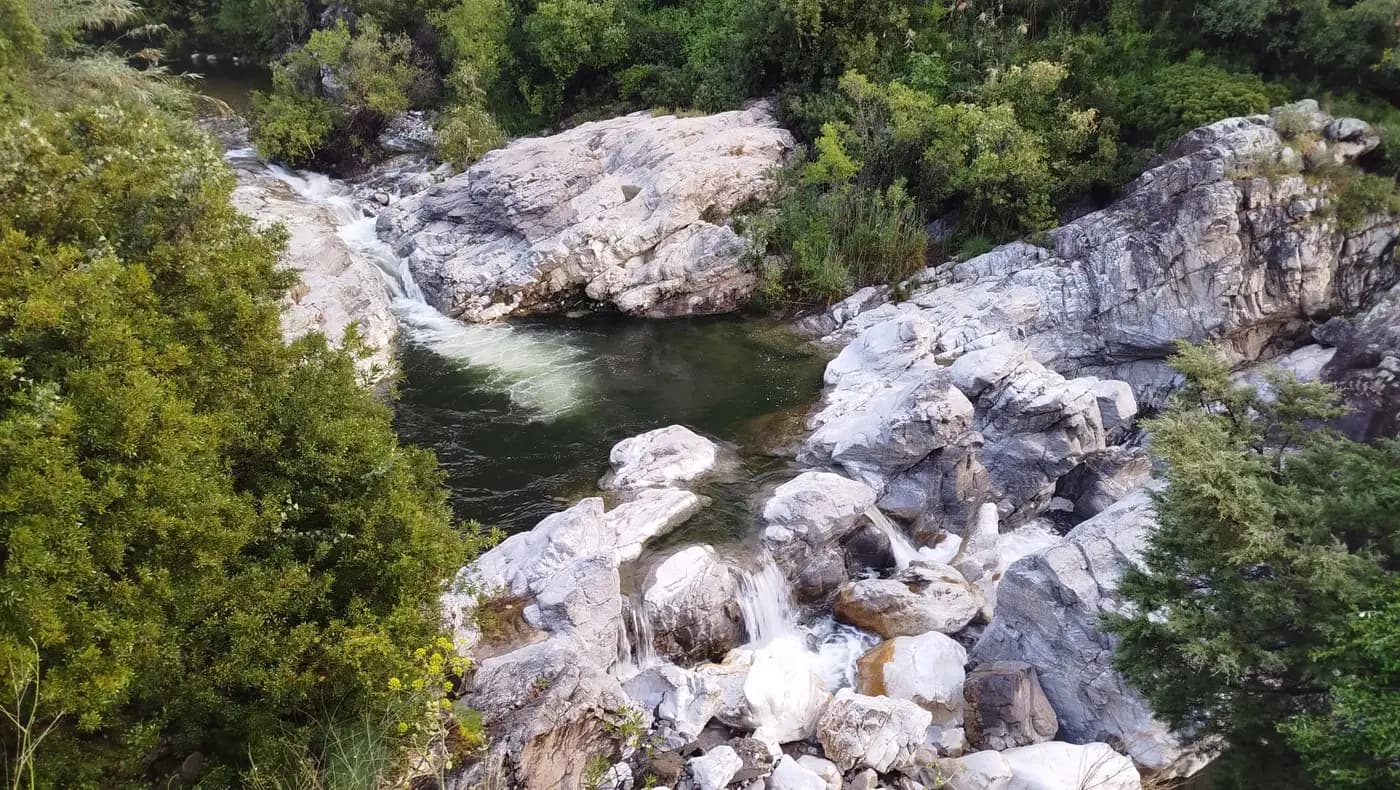
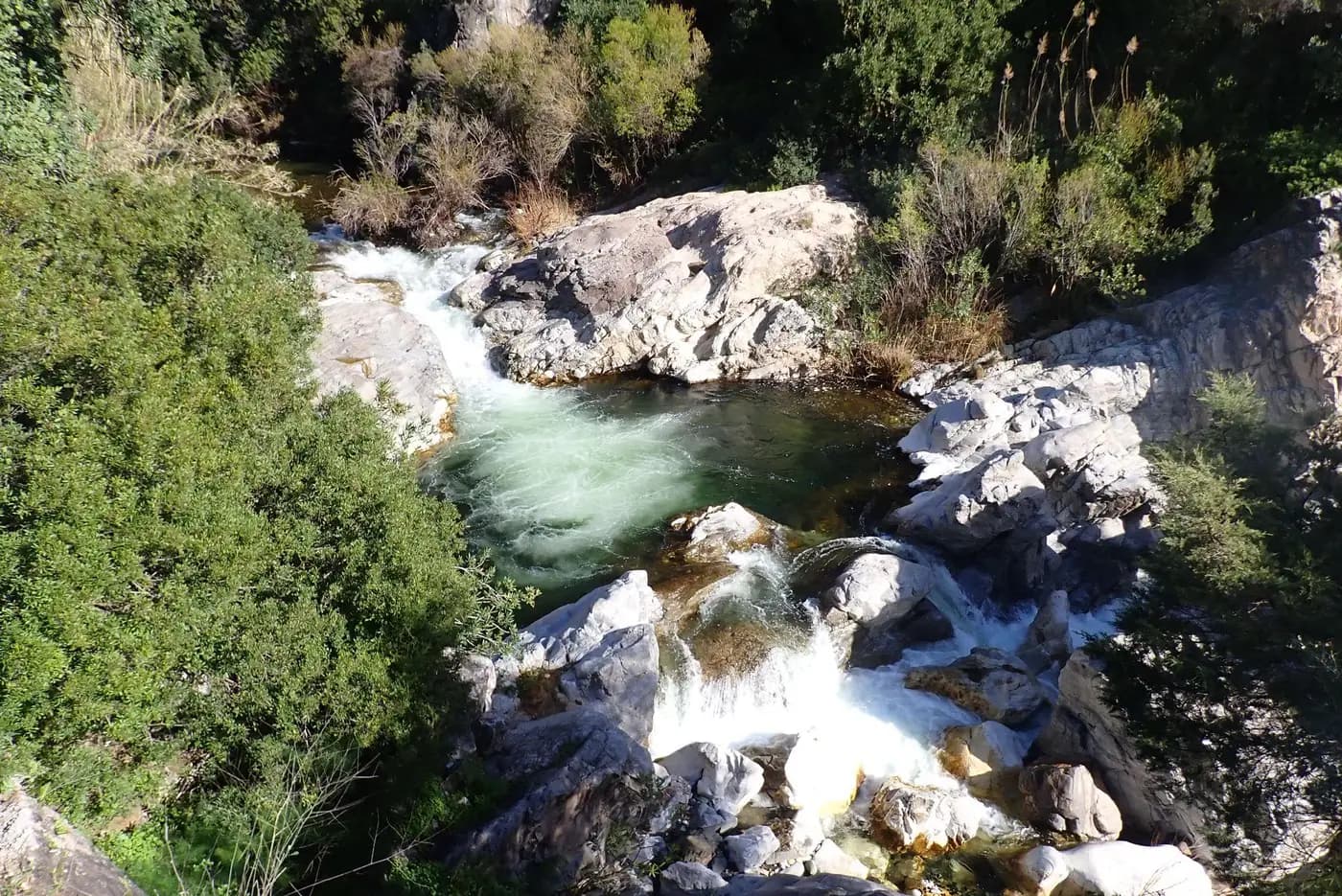
Guadalmina has one more thing to check: a dam just upstream of the canyoning section. It is an overflow dam: it has no spillway through which operators can decide when to release water, so once it is full, it simply overflows. Structures that hold back runoff can lower flood risk, and in practice the dam keeps the flow fairly steady, so an ordinary rainy day barely changes how the canyon behaves. The guides walk up to the dam and check with their own eyes whether it is overflowing, or how much room it has left.
It is hard to say how much rain it takes to fill it, because that depends on how full it already was. The last time it overflowed, it took around four days of constant rain. When that happens, the flow rises and the descent is off the table.
All these signs and reference points help, but they do not make the decision on their own. Nobody is simply checking a list of numbers: the final call rests on the guide's judgement, and that comes from years in the same rivers. After 20 years or more in canyoning, reading the water becomes almost instinctive. This is why, on days like these, who is leading your group matters more than anything else.
What a bit of rain adds
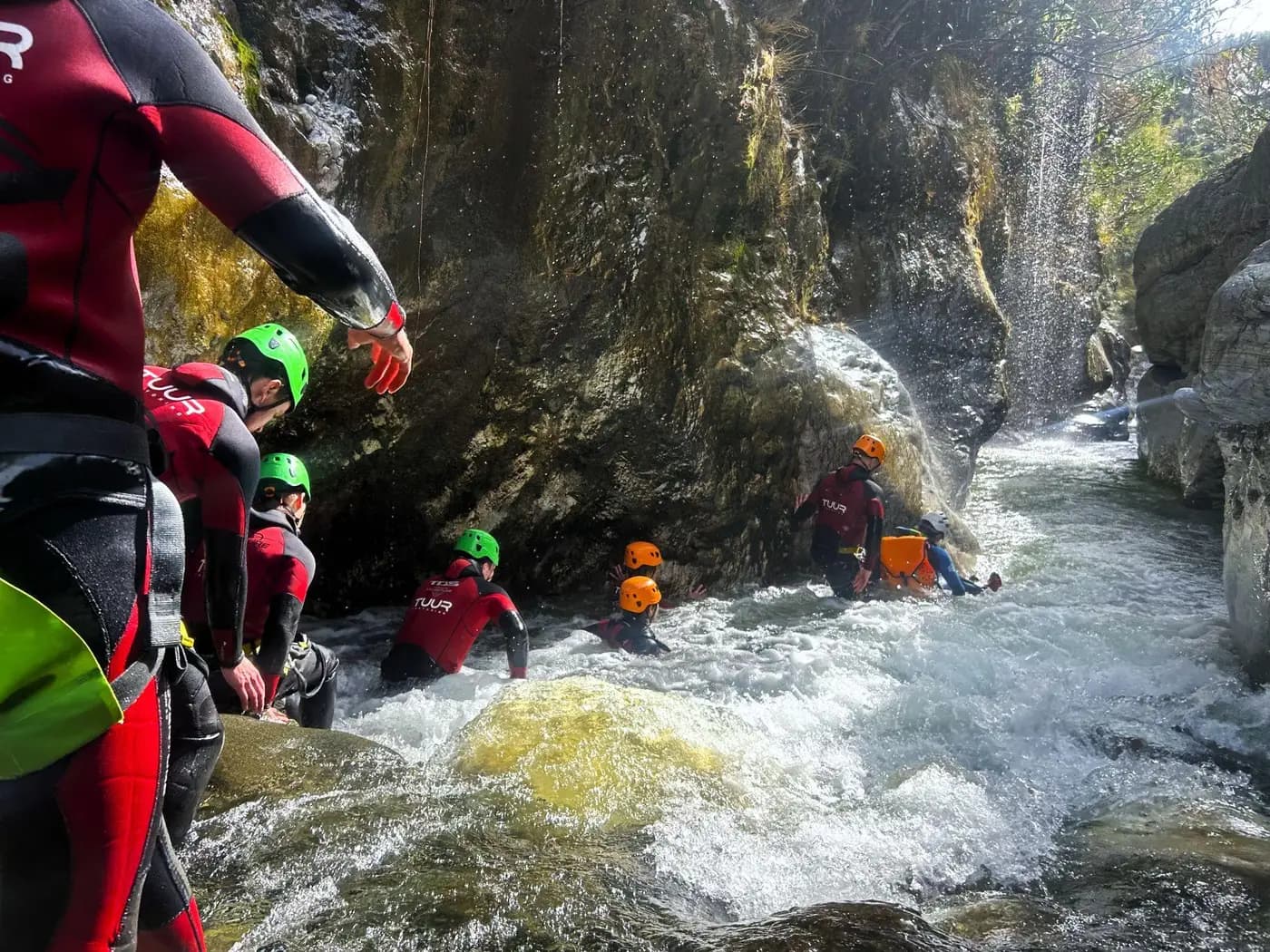
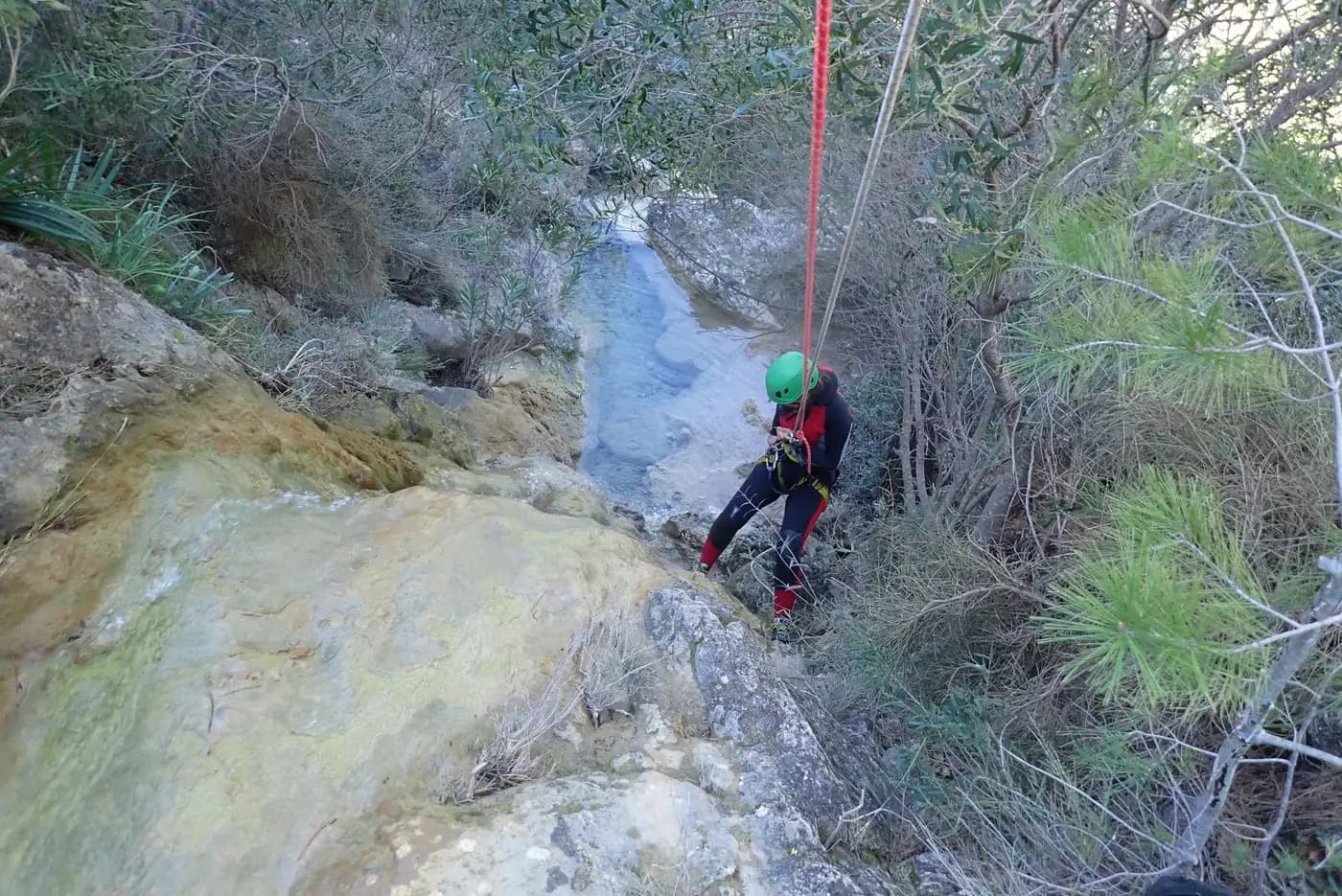
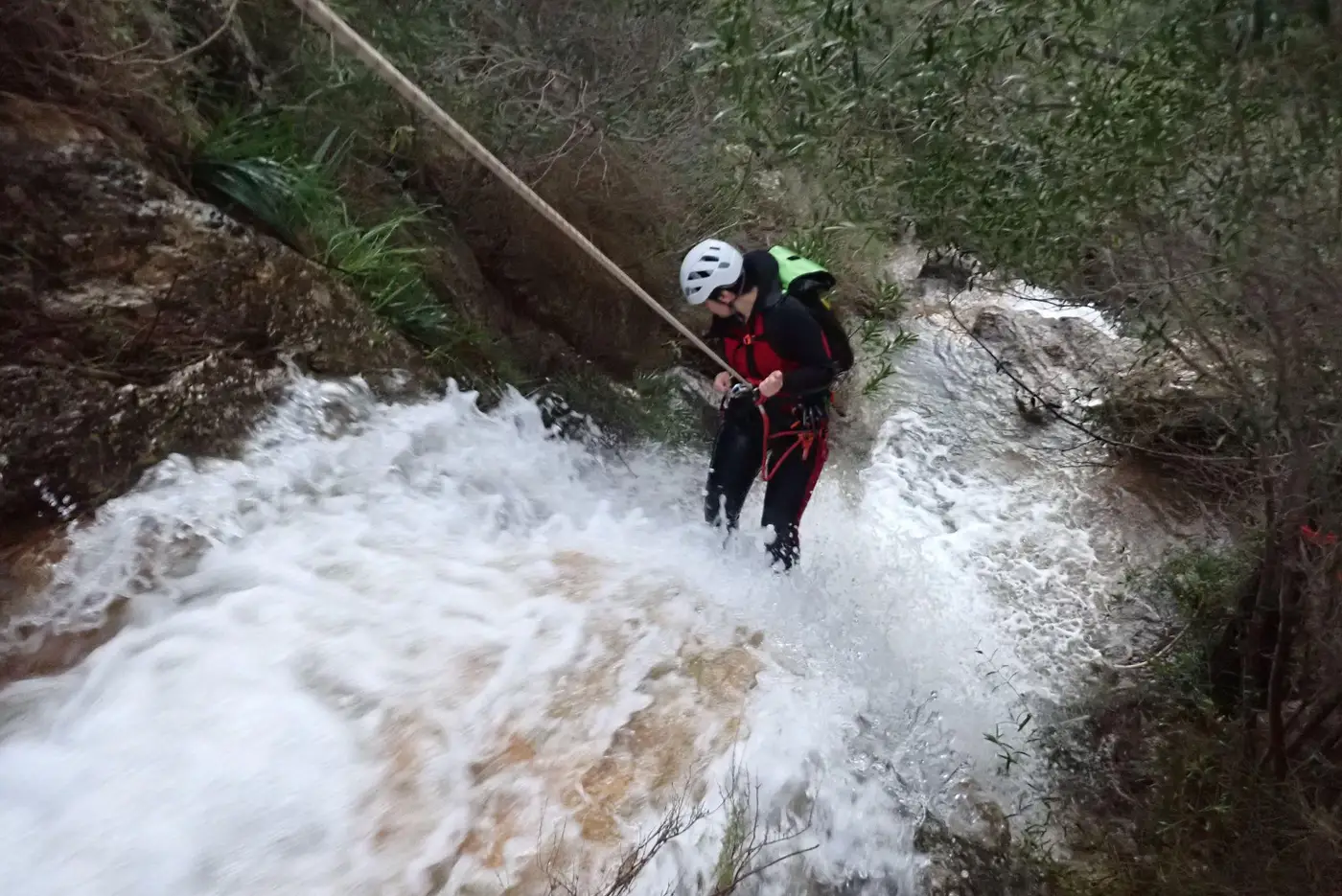
With more water in the river, canyons like Guadalmina change character. Waterfalls and natural slides that you rarely see in summer appear, and the pools get deeper. That extra depth also makes it possible to jump from higher spots than usual, because there is more water to land in safely.
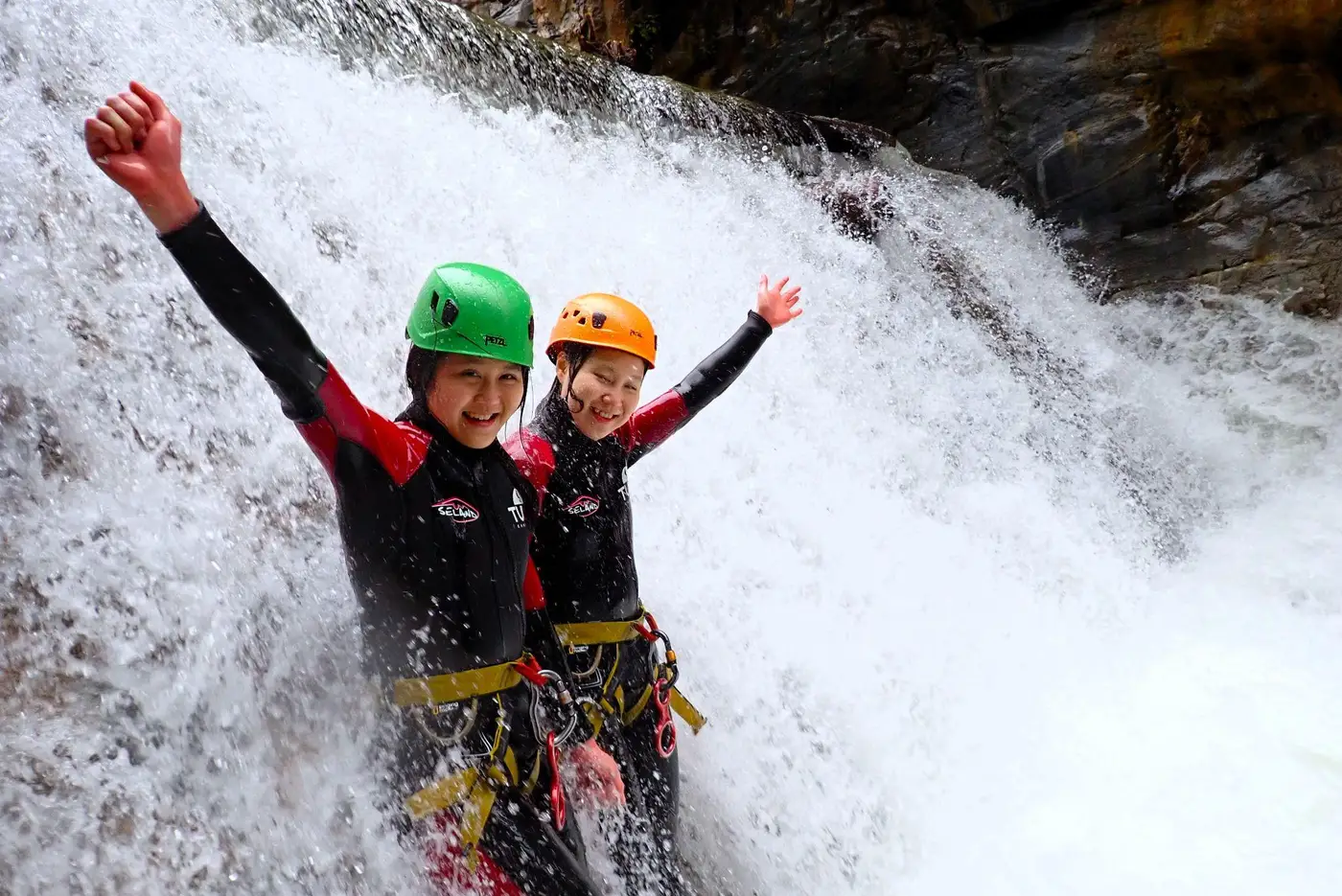
It is perfectly possible to enjoy canyoning on a calm rainy day with high-quality, regularly inspected neoprene and safety gear, and it shows a side of the canyon that most summer visitors never see. The blues and greens get more intense, and the canyon feels wilder, as if you were somewhere deep in the Amazon.
Who it suits best
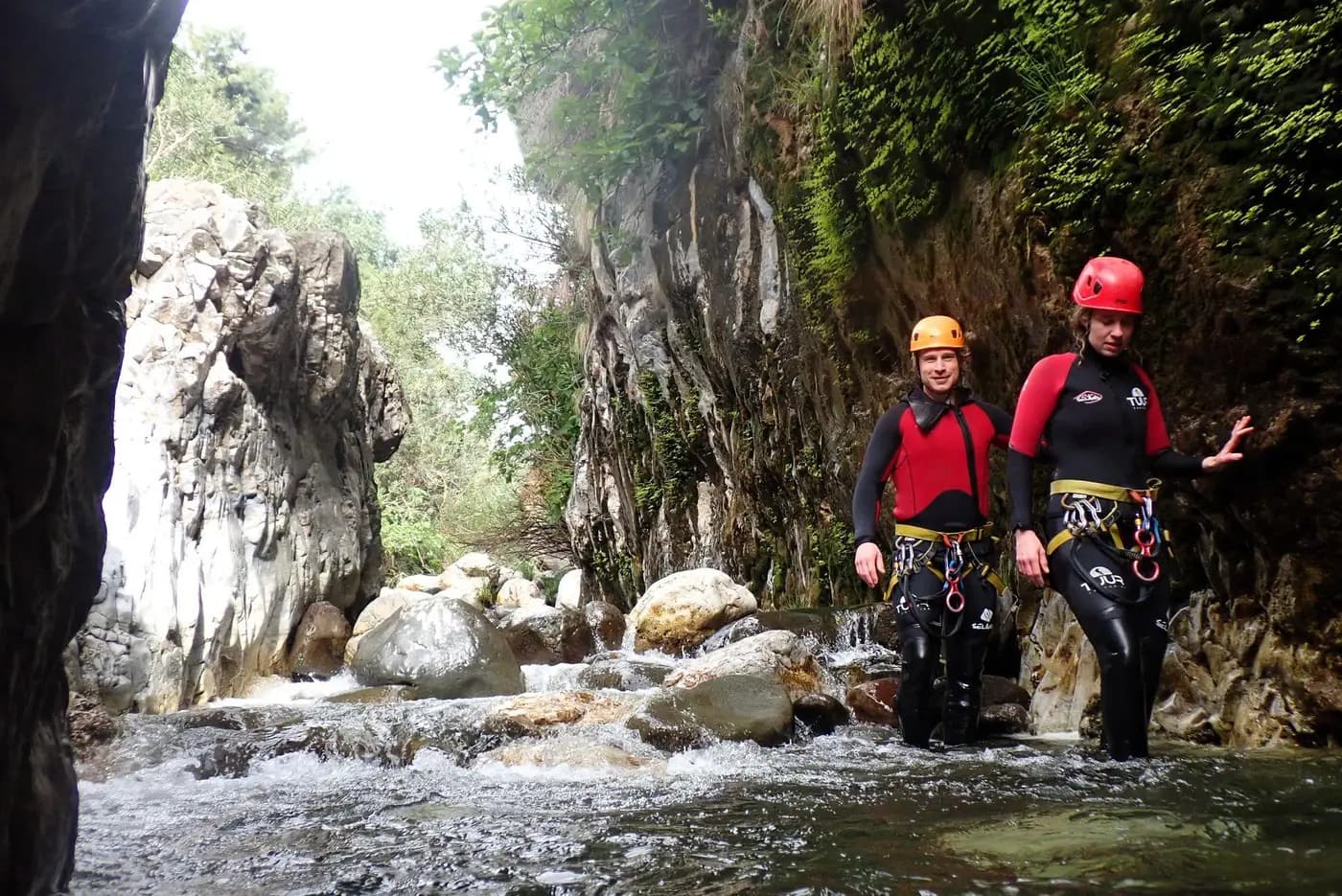
More water also means more force. For example, in winter, the Guadalmina Canyon minimum age rises from 6 to 12 years and the minimum weight, from 18 kg to 50 kg. When the flow is high, the range of suitable participants narrows even further: you need better physical condition, and enough body weight so the current does not push you around. This tends to happen in the wettest months, usually February and March and sometimes April and May.
☀️ Summer
6+ years
18+ kg
🌧️ Winter
12+ years
50+ kg
Your guide will tell you before the start if conditions call for any change.
Experience matters more than equipment
Not every operator has the experience or the know-how to work in these conditions. Reading a canyon after rain is a specialist skill, and it is very different from leading a walking tour. Before booking, it is worth asking who will lead your group (a certified canyoning guide*, or a general tourist guide?), what they check before entering the water, and what happens if the weather turns.
*How to recognise a qualified canyoning guide
In Spain, the official title is Técnico Deportivo en Barrancos, a state-recognised sports qualification of 1,440 hours that covers leading groups through canyons (as well as summer mid-mountain routes and via ferratas). The Spanish Mountain Guides Association (AEGM) lists its members under "Guía de Barrancos / Técnico Deportivo en Barrancos". Companies and self-employed guides must also be registered in the active tourism register.
You may come across other qualifications too: related sports technician titles (TECO, TAFAD, TSEAS) and credentials accredited by AEGM or UIMLA. The international ICAN canyoning certification covers the same knowledge, and its holders can be perfectly capable guides, but in Spain it is not valid on its own without one of the qualifications above.
In our own team, on days with a lot of flow only the most experienced guides go out, even in a canyon as friendly as Guadalmina.
Local knowledge adds one more layer. A guide who has seen the same river in every season for many years knows how the whole basin responds to rain, and that is something no forecast app can tell you.
If the weather turns
Any serious operator should be able to explain what happens when conditions change. Here, the certified guides have the final say: they can modify or suspend any activity if the weather puts the group at risk, and they keep you informed about the conditions before the start. If heavy rain or adverse weather forces a change, the steps are:
- 📅
1. Postponement
We first make every effort to reschedule the activity for a new date.
- 🪧
2. Alternatives
We may offer a different adventure route that is safer under the current conditions (whether it's another canyon that does have the optimal conditions or another alternative activity).
- 💶
3. Refund
If rescheduling or an alternative is not possible, you receive a 100% refund, excluding non-refundable external services such as transport or restaurant bookings that were already confirmed.
Plan B: canyons that come alive with the rain
When even Guadalmina is not safe, the day does not have to end there. This is the alternative route from the steps above, and it is where local knowledge pays off the most.
Some canyons are dry for most of the year. When the rain arrives they fill with waterfalls and run with a force you never see in summer, which makes them spectacular. In the right conditions they can also be safe: our guides know how each of them behaves, when it is at its best, and when it is better to stay out.
In the mountains of Málaga, these are the best-kept secrets of local canyoning guides. You will not find them offered anywhere, not even on our website, because they only make sense on certain days, after certain rain. They can be done when they are dry, but they lose much of the excitement.
So if the forecast looks bad and Guadalmina is off the table, ask us what is possible that day. If no route is safe, the refund still applies.
How cold is the water in winter?
As we said at the start, this guide is about the south of Spain, and water temperature is a good example of why that matters. In the Pyrenees and other high mountain ranges, canyons are fed by snowmelt and the water stays cold even in summer. The Barranco del Furco, one of the most popular beginner canyons in the Aragonese Pyrenees, is open from April to October and its average annual water temperature ranges from 7 °C to 10 °C, because the lakes are fed directly by snowmelt and high-mountain streams. Many other Pyrenean canyons are open only from May or June to September or October.
Andalusia is not uniform either, and many of its best-known canyons are not an option in winter because of the water temperature and the flow. Río Verde runs from April to October, with its best conditions from May to September, and Buitreras from mid-May to the end of November, always depending on water levels and safety conditions. Zarzalones is the exception: it starts at the spring of the Río Grande, which keeps the water flowing all year. And Guadalmina, our main canyon, is a different case again.
Guadalmina has no snowmelt or high mountains upstream, so its water stays mild all year. Our guides' rough figures are around 24 °C in summer and 18 °C in winter.
🌡️ Summer
~24 °C
🌡️ Winter
~18 °C
What to wear in winter
Water pulls heat from your body much faster than air does, which is why wetsuits are standard canyoning gear even in hot climates. In summer, adults wear only the sleeveless neoprene vest. From September or October, when the weather conditions change, we add a long-sleeve jacket over it, mandatory on cold days and throughout winter, and neoprene socks to wear inside your shoes. Our neoprene is 5 mm thick, so vest and jacket together give around 10 mm over the torso, with double insulation where your vital organs are. The neoprene also cushions bumps and scratches and adds buoyancy, which helps when the water is livelier.
The wetsuit, harness, helmet and descending equipment are all included. For your feet, bring hiking boots (ideally with a grippy sole) or rent our professional canyoning shoes, which offer optimal protection and a non-slip sole on wet ground. Open footwear such as flip-flops is never allowed. Beach or pool water shoes (aqua shoes) are not suitable either: they are extremely slippery on wet rock, and too flexible to protect your feet when walking on rocks or from possible impacts. You only need to bring a towel and a full change of warm, dry clothes for afterwards. For more details, see our guide to basic canyoning equipment.
Frequently asked questions
Is it safe to go canyoning when it rains?
It depends on the canyon and on how hard it rains. In Guadalmina, light or moderate rain is usually fine thanks to the dam upstream. Several days of heavy rain are a different story, and our guides will not go ahead if conditions are unsafe.
Can a canyon be dangerous even if it is not raining where I am?
Yes. A canyon is fed by the whole river basin around it, so heavy rain in the mountains upstream can raise the flow hours later, even under a clear sky. That is why our guides study the basin, the previous days and the reservoirs, not only the sky above the canyon.
Will you cancel my activity because of a bit of rain?
No. We only change plans when the conditions are unsafe. If that happens, we follow the protocol above: postponement, an alternative route, or a refund.
Can I go canyoning in Guadalmina all year round?
Almost all year, apart from extreme circumstances. The wettest months are usually February and March, and sometimes April and May.
Can I go canyoning in winter in other canyons near Marbella?
Not in all of them. Zarzalones is open all year, while Río Verde (April to October) and Buitreras (mid-May to November) have a season that depends on water levels and conditions. Ask us which canyon suits your date.
What is the water temperature of the Guadalmina River in winter?
Guadalmina has no snowmelt or high mountains upstream, so the water stays mild all year. Our guides' rough figures are around 18 °C in winter and 24 °C in summer. In winter we add a long-sleeve jacket and neoprene socks, which together with the vest give around 10 mm of neoprene over the torso.
Can children join Guadalmina Canyon in winter?
In winter, the minimum age is 12 years and the minimum weight is 50 kg. When the river is high, the requirements can be stricter, so ask us before you book.
What if the activity is cancelled because of the weather?
If we cannot reschedule or offer an alternative, you get a 100% refund, excluding any non-refundable external services (such as transport or restaurant bookings) that were already confirmed.
Does the weather policy apply if I booked through a travel platform?
Yes. The same policy applies on every booking channel, because most platforms accept cancellations for force majeure.
Planning a visit?
If you would like to see Guadalmina in winter, you will find details and availability on our Guadalmina canyoning page. Not sure about the forecast? Write to us before you book and we will tell you how the canyon looks that day.
Looking for something different? We also run Zarzalones, Buitreras and Río Verde, each with its own season, so ask which one is in good condition on your date.
Want to See Guadalmina in Winter?
Check availability or write to us before you book and we will tell you how the canyon looks that day.
Sources
- Canyoneering Safety, Zion National Park (U.S. National Park Service)
- Flash flood risks in Blue Mountains canyons (Fat Canyoners)
- Catchment areas and flash flood risk in canyons (Ozultimate)
- Upstream precipitation (RopeWiki)
- Real Decreto 702/2019, Técnico Deportivo en Barrancos (BOE)
- Técnico Deportivo en Barrancos, grado medio (Junta de Andalucía)
- Find a guide (AEGM)
- The Top 10 Canyoning Spots in the Pyrénées (Manawa)
- Barranco de Ferreras (OpenCanyon)
- TUUR canyon pages: Zarzalones, Buitreras, Río Verde
TUUR Adventure Experts
Published: November 4, 2026 · 11 min read